

In a bid to further enhance public safety and protect lives, the Rift Valley Regional Security Team has launched a region-wide operation explicitly targeting illegal alcohol production, distribution, and consumption. The operation brings together the multiple security agencies involved in what has been called by officials as a concerted effort to dismantle illegal alcohol networks that have been a threat to communities for far too long.
Numbers of deaths, family breakups, reduced economic productivity, and increased crime have been synonymous with illicit brews, making this operation esoteric for public safety-A National Police Service (NPS) operation conducted alongside the Administration Police (AP) and Directorate of Criminal Investigations (DCI).
Multi-Agency Operation Targets Illegal Alcohol Dens
The highly organized joint operations debate was held at a high-level regional security meeting in Mtelo Hall, Kapenguria, West Pokot County, with senior security commands from Turkana, Trans Nzoia, Elgeyo Marakwet, and Uasin Gishu counties in attendance. This meeting highlighted the regional scope of the problem and called for coordinated response.
According to officials, the operation would target the identification and closure of illegal brewing dens, arresting those implicated along the supply chain, and disrupting distribution networks across counties and international borders. Agencies involved will also beef up patrols and intelligence-led operations in known hotspots.
Security leaders revealed that the very easy access of illicit brews comes with dire social results, increase in domestic violence, neglect of family responsibilities, rising petty and organized crime. Therefore, the ongoing crackdown intends not only to apply law but also to deter any new attempts to legalize such activities and restore social adjustment.
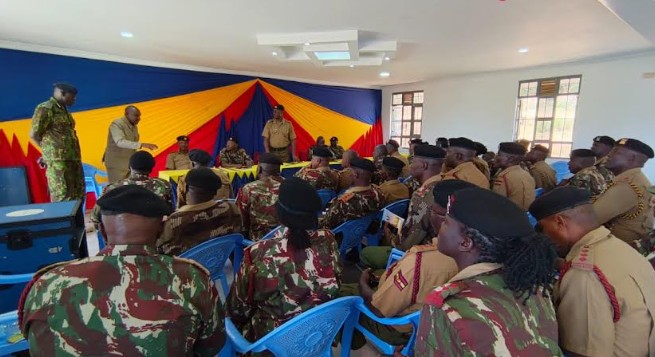
Senior commanders from Turkana, Trans Nzoia, Elgeyo Marakwet, and Uasin Gishu counties attended the meeting. Photo/Courtesy
Porous Borders and Regional Insecurity Raised Alarm
During the Kapenguria meeting, officials raised concerns on the porous borders of the region with Ethiopia, Sudan, and Uganda, which are points of entry for illicit alcohol and other contrabands. Hence, security agencies would like to strengthen border surveillance, enhance intelligence sharing, and work with local communities to address cross-border smuggling.
Rift Valley Regional Police Commander Samuel Ndanyi, emphasizing the need for inter-agency collaboration, appealed to institutions such as the Kenya Bureau of Standards (KEBS), National Authority for the Campaign Against Alcohol and Drug Abuse (NACADA), Kenya Revenue Authority (KRA), and National Government Administrative Officers (NGAOs) to support this operation.
Ndanyi strongly warned against sabotage within, saying that any officer found to be undermining this crusade would be met with decisive disciplinary measures. He added that integrity within the ranks of the security forces is key to the successful delivery of this operation.
The commander further disclosed that this crackdown on illicit brews is yet another element of the broader regional security strategy, with similar consultative meetings planned to be held in other counties that are experiencing emerging threats.
Further, Ndanyi cited the ongoing challenge of banditry in parts of the Rift Valley, particularly during the dry season, as another pertinent issue. The Commander explained that competition over scarce resources like pasture and water is often the driving force of insecurity, leading to cattle rustling and violent confrontation.
If these authorities remain hopeful that there will be sufficient synergy from all agencies, with the involvement of the public, then the injuries caused by illicit brews will greatly reduce and result in long-lasting peace and stability in the Rift Valley.












Leave a Reply